Prompts
Each week I’ll add a new prompt to this page. Use the readings or writings assigned to guide your posts on your individual blogs. (Readings can be found in our course Google Drive folder, and your assignments for each week are listed on the Course Schedule page.) For tips on what I’m looking for in your posts, check out the About page and the description on the Assignments page. For directions on how to make a post on WordPress, check out this link. Always feel free to use images, audio, video. links, memes, etc. – anything that supplements your writing. If you ever have any questions, I’m just an email away.
Week Two – Posts due Wednesday, September 5th by 8am:
For your first blog post, please respond to one of the following questions:
From Catherine Ramsdell’s chapter: “Maxwell and Dickman believe that “a story is a fact, wrapped in an emotion that compels us to take an action that transforms our world.” How would you define the term story? What do you think are the most important elements of a good story? What examples help support your thoughts?” Base your claims in ideas addressed in Ramsdell’s chapter.From Ramsdell’s chapter: “How could stories and storytelling fit into your major field of study? What types of stories do you think professionals in your field might find useful?” Point to specific moments in Ramsdell’s chapter to support your claims.How does Gloria Anzaldua use some of the elements of storytelling discussed in Ramsdell’s chapter? Given Ramsdell’s points, do you think Anzaldua is a “good” storyteller? Why or why not? Use evidence from Anzaldua’s text to back up your points.
Week Three – Posts due Monday, September 10th by 8am:
Respond to one of the following questions:
1) Answer the following questions from the end of Lamott’s essay: “From what Lamott has to say, is writing a first draft more about the product or the process? Do you agree in regard to your own first drafts?” For you, what does “the writing process” entail? Give examples and explain your reasoning.
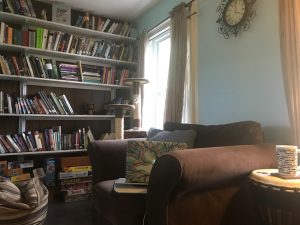
2) We’ve been talking about descriptive writing in class, and how important details are in order to communicate to your audience and to become a better storyteller.
We all have connections to particular places with our writing processes – spots that helps us “get in the zone.”

I prefer my favorite cozy chair, my backyard, coffee shops, the NYPL – all for different reasons, but ultimately because those are all spaces I’m able to grasp the strain of idea that I’m trying to get a hold of. Do you think our surroundings – geographical location, environment, time of day, the company we keep as we write, etc. – directly impact our composing?

Why or why not? What are your sites of composing? What spaces and places are you most comfortable composing in, and why? What does each site offer you? Instead of using just text for this blog post, use images as well as a way of composing visually. Use descriptive writing to bring those images to life for your readers.
Week Five – Posts due Monday, September 24th by 8am:
This week’s prompt comes from our reading by Laura Bolin Carroll: “What is an example of a rhetorical situation that you have found yourself in? Discuss exigence, audience, and constraints.” Remember our in-class discussion of summary and analysis. Include both sufficient details to describe what happened (summary) along with sufficient explanation of the meaning you see in the situation (analysis). Your response should describe WHAT happened, WHY it happened, and HOW it happened.
Week Six – Posts due Wednesday, October 3rd by 8am:
In our discussion of the canons of rhetoric last week, we learned that one of the five canons is media, which refers to the medium of the message or text. Later in the semester, we’ll be talking about multimodality (or multiple mediums) as a rhetorical tactic. Think about how you processed the NPR podcast we’ll be discussing in class. What were the affordances of an audio-based medium? In other words, why use a podcast instead of, say, a video, to tell the stories about weight and body image? Think of a time when you’ve had to use an aural or audio-based form to effectively communicate a message. Describe the scenario, and explain why you chose to use an audio-based form instead of some other medium.
Week Seven – Posts due Wednesday, October 10th by 8am:
This week’s blog post prompt comes from our textbook: “Make an inventory of all your past experiences with collaboration. Think broadly about when, where, and how you have worked with other people on any kind of project. List all the ways in which your collective efforts resulted in a better outcome than individual work might have provided. What challenges did you face? How did you resolve them? Write a short personal guide for your peers about working collaboratively” (Losh and Alexander 216).
Week Eight – Posts due Wednesday, October 17th by 8am:
In our reading this week, Losh and Alexander discuss the complexities of the research process. They show the importance of organization, give advice on searches and citation, and discuss reliability in sources. Many of you referred to sources that would be considered… well, less-than-reliable in a research paper for the Rhetorical Analysis project. Think about your own research processes so far – for this class and for other classes. How do you research? Where do you look, and how do you decide what phrase or keywords will be helpful? Based on Losh and Alexander’s advice, and based on the workshop at the library on Monday, how will your process change?
Week Ten – Posts due Wednesday, October 31st by 8am:
After reading Losh and Alexander’s chapter on forming complex arguments, respond to the following question from p. 190: “Choose an episode of a TV show you’re very familiar with, and try to think about the kinds of ‘arguments’ the show makes outside of its plot. (Crime dramas often argue against government bureaucracy as much as they clearly take a stance against crime.) Once you have some thoughts on the show’s arguments, think about how it goes about making those arguments: is it purely through storytelling, or do visuals and other elements [sound, movement, etc.] play a part as well?” Feel free to include images or video clips from the show in your post in order to help emphasize your discussion.
Week Eleven – Posts due Wednesday, November 7th by 8am:
For this week’s post, we’re doing some brainstorming for your final project. Consider the following questions. Where do you see your project going? How will you use multimodal composing to get your message across effectively?
What is your problem?What can you do about it?How are you going to make this local?Who is your audience?How can you persuade that audience to act with you?
Week Thirteen – Posts due Monday, November 19th by 8am:
In this week’s reading, Losh and Alexander discuss revision practices. For your post this week, describe your own revision processes. What steps do you take to revise your work, and where do those steps match up with the advice given in Losh and Alexander’s Issue 7? Use evidence form the chapter to support your claims. To echo their question from the end of the chapter, what is some of the best and worst revision advice you’ve been given? How has that impacted your writing? Based on your own experiences, what revision advice would you give writers who will be starting college next year?
This page will be updated each week. Check back here for new prompts.
