Plagiarism, Citation, and Source Integration Exercises, 10/29/18
I. Plagiarism
Take a look at this infograph for a comprehensive breakdown of different types of plagiarism and their severity:
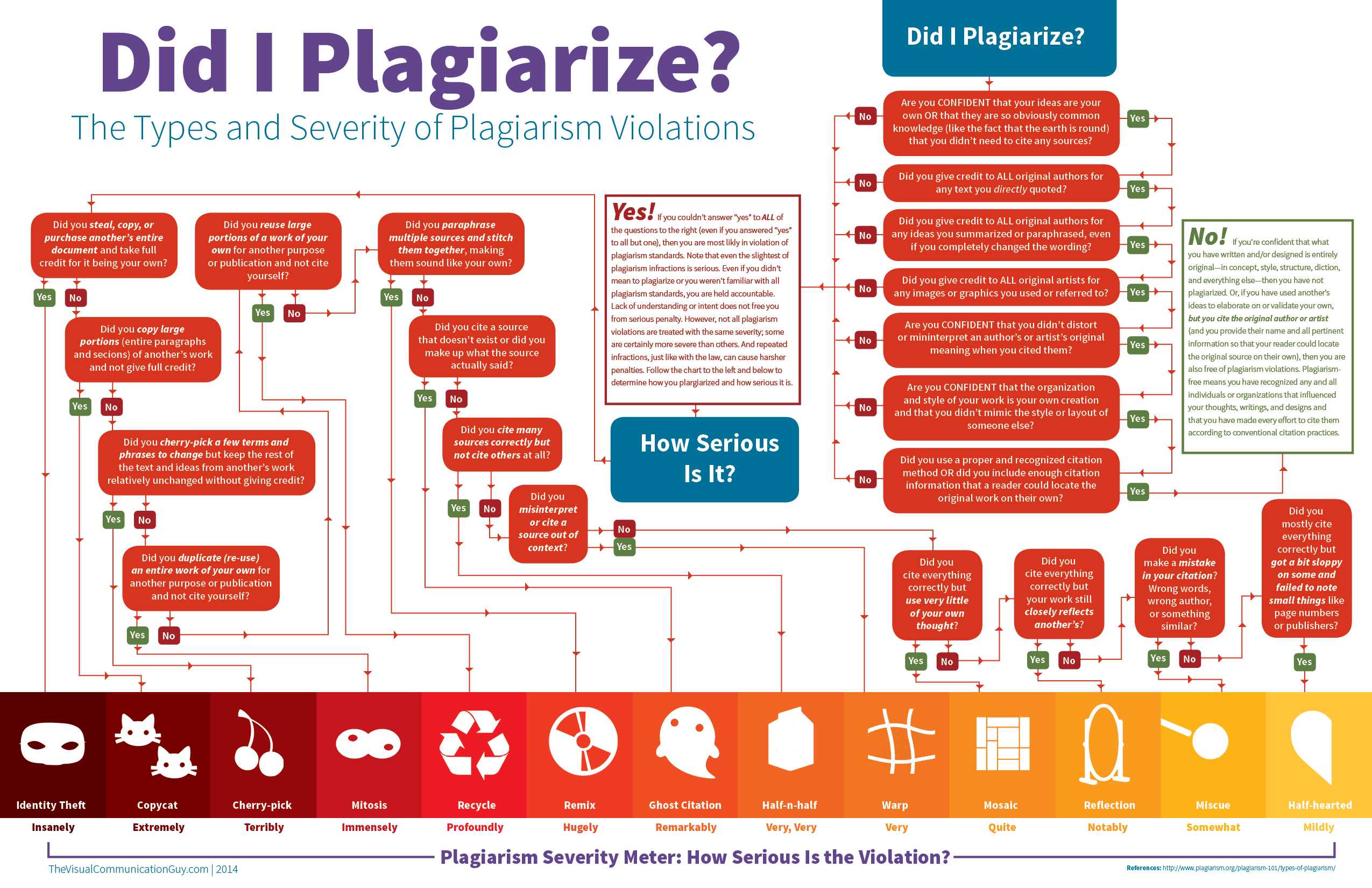
II. Source Integration Examples
This website’s description of integrating sources should be extremely helpful as you begin to work on the first draft of your inquiry project.
Additionally, here are some example paragraphs for source integration*:
Bad source integration:
- Black Elk often spoke of the importance of the circle to American Indian culture. “You may have noticed that everything an Indian does is in a circle, and that is because the Power of the World always works in circles, and everything tries to be round… The sky is round, and I have heard that the earth is round like a ball, and so are all the stars.” He couldn’t understand why white people lived in square houses. “It is a bad way to live, for there is not power in a square.”
This writer allows the quotes to stand out awkwardly from his/her own writing. The author could have integrated this source more effectively if he/she had worked this material smoothly into his/her own writing.
Good source integration:
- Black Elk believed the “Power of the World always works in circles,” noting the roundness of the sun, the earth, and the stars. He couldn’t understand why white people live in square houses: “It is a bad way to live, for there is not power in a square” (Black Elk, 1961, p. 175).
This time around, the writer has paraphrased and condensed most of the long, direct quote from before. As the author does this, they avoid a wordy integration (e.g. using phrases such as “This quote states…” or “I chose this quote because…”) Now the source’s information fits smoothly into the author’s own sentence.
Here is an example of a complete paragraph using good source integration. Note that the writer not only works the source information into his/her own sentences smoothly and without extra wordiness, but also that he/she is using multiple sources within the same paragraph – something that is key for good source integration and a good paper.
- There is more to this show than meets the eye, certainly. It is definitely more than just a crowd of furry animals all living together in the middle of New York City. Originally intended as an effort to educate poor, less privileged youth, Sesame Street is set in the very middle of an urban development on purpose (Hellman, 1996, p. 52). As Jon Stone, one of the show’s founders and co-producers sees it, the program couldn’t be “just another escapist show set in a tree house or a badger den” (1985, p. 52). Instead, the recognizable environment gave something to the kids they could relate to. “…It had a lot more real quality to it than, say, Mister Rogers… Kids say the reason they don’t like Mister Rogers is that it’s unbelievable,” says Nancy Diamonti (2005).
*FROM BRUCE BALLENGER, THE CURIOUS RESEARCHER, 2007, PP. 203-205
III. Source Integration Exercise 1
In your group, look at the passage below. Then, look through the student’s source integration attempt. How would you change this paragraph in order to smoothly integrate the source? How would you incorporate better paraphrases, quotes, and in-text citations in order to avoid plagiarism?
From Gloria Anzaldua, “How to Tame a Wild Tongue”:
So, if you want to really hurt me, talk badly about my language. Ethnic identity is twin skin to linguistic identity – I am my language. Until I can take pride in my language, I cannot take pride in myself. Until I can accept as legitimate Chicano Texas Spanish, Tex-Mex, and all the other languages I speak, I cannot accept the legitimacy of myself.
Student’s Source Integration Attempt:
Feminist activism does not always take place in a protest, however. Many feminists focus their activism in education. Gloria Anzaldua, a Chicana feminist, did both, and often emphasized oppressive language in her work in educating people. Ethnic identity is twin skin to linguistic identity – I am my language. In that quote, Gloria makes a connection between racism and languages. It proves the point of what I said in my previous sentences. Until I can accept as legitimate Chicano Texas Spanish, Tex-Mex, and all the other languages I speak, I cannot accept the legitimacy of myself.
IV. Source Integration Exercise 2
I’d like us to take a moment practicing integrating sources effectively in our own writing. Take about 20-25 minutes to respond:
Given what we read in Elliot and Sullivan’s article last week, and given the Red Cross’s rebuttal found here and here, do you think a majority of disaster relief donations should continue to go through the Red Cross? Why or why not?
Use evidence from the articles to support your claims, using the conventions of source integration and citation that we’ve been discussing together. Your response must include at least two paraphrased ideas and one direct quote. Remember, as well, that your paragraph should be a PEAS (Point, Evidence, Analysis, Synthesis) paragraph.
